Shopping Cart
0Your cart is empty
Start ShoppingWhat Is Mahjong? The American Mahjong Boom Explained
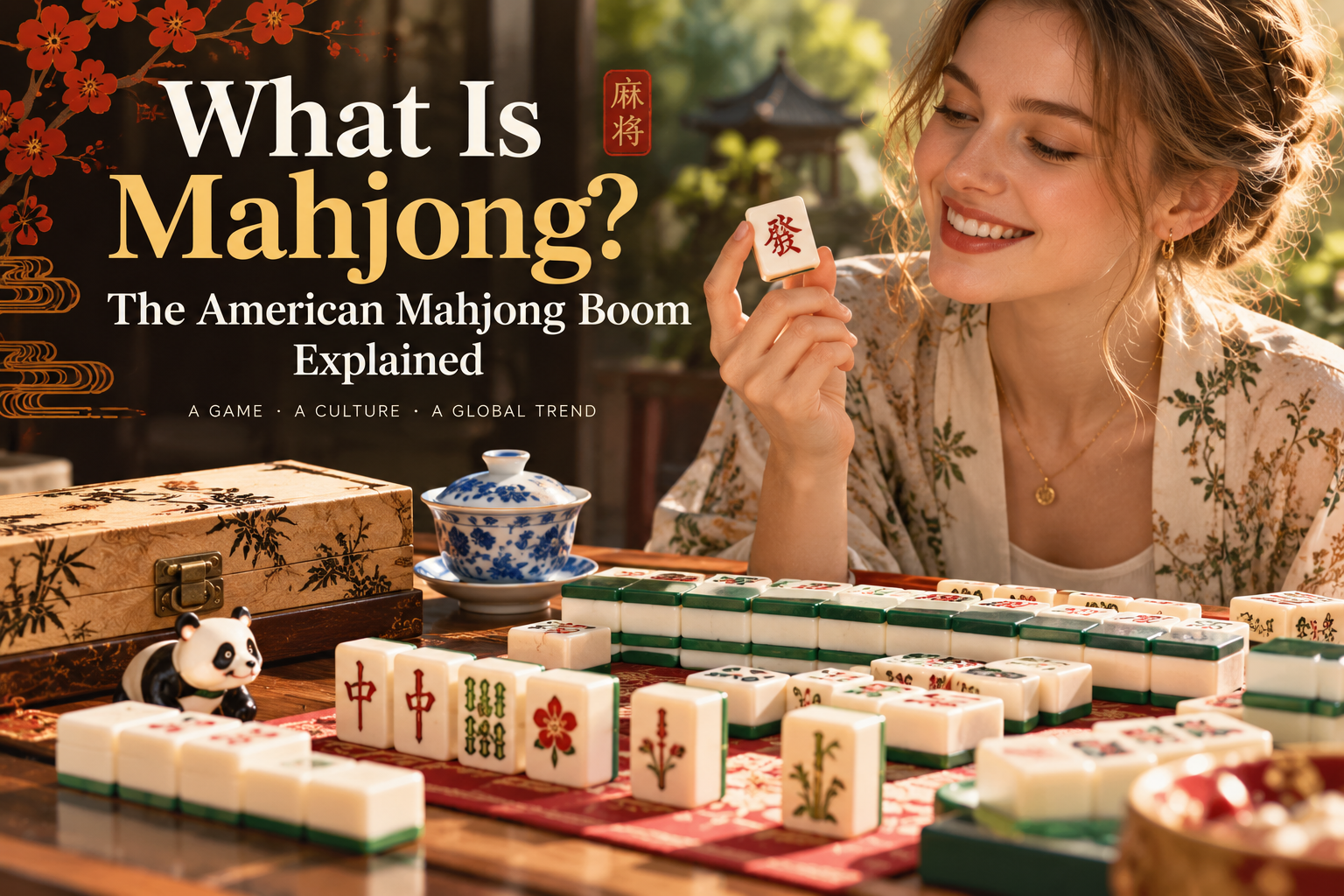
On a Tuesday night in a Boston community centre, two dozen women sit four to a table around rows of ivory-coloured tiles, slamming discards down with a sound like hail on a roof. The same scene repeats in Santa Monica, Austin and Queens. The game is mahjong — born in 19th-century China, turned into a national pastime in Sichuan, and now enjoying the biggest boom in its hundred-year history in the United States.
According to Etsy's own 2026 trend reporting, searches for mahjong tile racks rose roughly 228% year on year, and Gen Z mahjong sets were up around 178%. Third-party keyword trackers put monthly marketplace searches for "mah jong" in the millions, at unusually low competition for the volume. So what is the game, why is it exploding now — and how different is the version they play in Chengdu?
What Exactly Is Mahjong?
Mahjong is a four-player tile game played with roughly 144 pieces, usually bamboo-backed plastic or resin. The tiles are grouped into suits (bamboo, characters and dots), honour tiles (winds and dragons) and optional flower and season tiles. Players draw and discard in turn, trying to assemble a complete hand of matched sets — sequences, triplets and a pair — rather like a poker hand built one tile at a time, with memory, probability and ruthless reading of opponents.
The game developed in 19th-century China and spread worldwide in the 1920s, when an American businessman named Joseph P. Babcock simplified and exported the rules from Shanghai. Crucially, every country that adopted it then changed it — which is why "mahjong" today means meaningfully different games depending on where the table is.
Two Mahjongs, Two Personalities
| American Mahjong | Sichuan Mahjong | |
|---|---|---|
| Goal | Build one specific "card of the year" hand | Only two suits allowed; win fast, win often |
| Rules | A new official card every year, jokers, Charleston pass | "Blood battle" — winners keep playing the same round |
| Who plays | Leagues, charity games, suburban social clubs | Literally everyone, outdoors, on every day off |
| Vibe | Social ritual — snacks, uniforms, table talk | Gambling-adjacent sport — loud, fast, theatrical |
American mahjong is organised: the National Mah Jongg League claims over 350,000 members, publishes the annual rule card, and anchors a tournament circuit. Sichuan mahjong is the opposite of organised. In Chengdu it is played on folding tables under trees in People's Park, in teahouse corridors, and beside construction sites, for stakes ranging from loose change to nothing at all. Both versions are social glue — but one wears pearls, the other wears slippers.
The Numbers Behind the Boom
- +228% — year-on-year rise in searches for mahjong tile racks on Etsy (Etsy 2026 spring/summer trend report)
- +178% — rise for Gen Z-targeted mahjong sets in the same report
- 350,000+ — members of the National Mah Jongg League, the American game's governing body
- Millions/month — estimated marketplace searches for "mah jong" tracked by keyword tools, with competition still rated low relative to demand
Cross-border retail reports from 2026 describe cheap mahjong accessories — tile holders, themed jewellery, table mats — selling in the hundreds of thousands of units in a single month. This is no longer a niche hobby restocking its closet; it is a gifting category being built in real time.
Why Now? Three Theories
1. The hunger for "third places"
After years of screens and isolation, mahjong offers what algorithmic entertainment cannot: a fixed weekly appointment, in person, where four people must actually pay attention to each other. American players consistently describe their games as social clubs that happen to involve tiles — the Tuesday-night group is the product; winning is the excuse.
2. Tactile joy in a touchscreen decade
The tiles click. They have weight. You shuffle them with both hands. Luxury analysts have spent five years documenting the same turn toward physical ritual in board games, stationery and vinyl; mahjong is the maximalist version — a 144-piece, heavily symbolic, photographable object that looks extraordinary on a Pinterest board. (Pinterest reports that the overwhelming majority of its searches are unbranded: people are browsing a feeling, and mahjong tables deliver one.)
3. Generational handover
The American game was carried for decades by grandmother leagues. Their granddaughters are now arriving via TikTok and Instagram, seeing the tables as aesthetic heritage rather than elderly recreation, and redesigning the accessories — pastel tile bags, modern racks, jewellery built from tile motifs — for themselves.
Listen to What the Fuss Sounds Like
Strip away the statistics and mahjong is, before anything else, a sound. In Chengdu the classic version is hand-rubbed: players mix the tiles face-down in a slow, grinding shuffle before the walls are built. Electric tables have mostly replaced it, making it a disappearing sound. We recorded it under a teahouse awning while a real game was happening around the microphone.
That recording, plus the electric automatic shuffle, the Chengdu subway pulse and rain in the old alleys, is part of the Chengdu City Soundscapes collection — five 30-second field recordings that document the city's everyday soundtrack. You can also stream a rotating selection free in the sound library.
Where the Boom Goes Next
Gaming fads usually flame out; ritual ones compound. Everything about mahjong — the league structure, the weekly cadence, the intergenerational transmission, the gifting around sets — looks more like tennis or bridge than a TikTok trend. The most likely future is not a crash but a broadening: more players, much more merchandise, and a slow bridge between the American social game and its louder, faster Chinese cousins.
If that bridge happens, it will probably happen over sound. The first thing a new player learns is that the game is not about the tiles you hold — it is about reading the table through the noises other people make. The tiles, in both Boston and Chengdu, always do the talking.
Numbers in this article are drawn from Etsy's published 2026 spring/summer trend reporting, the National Mah Jongg League's public membership figures, and third-party e-commerce keyword trackers; estimates vary by tool and month.